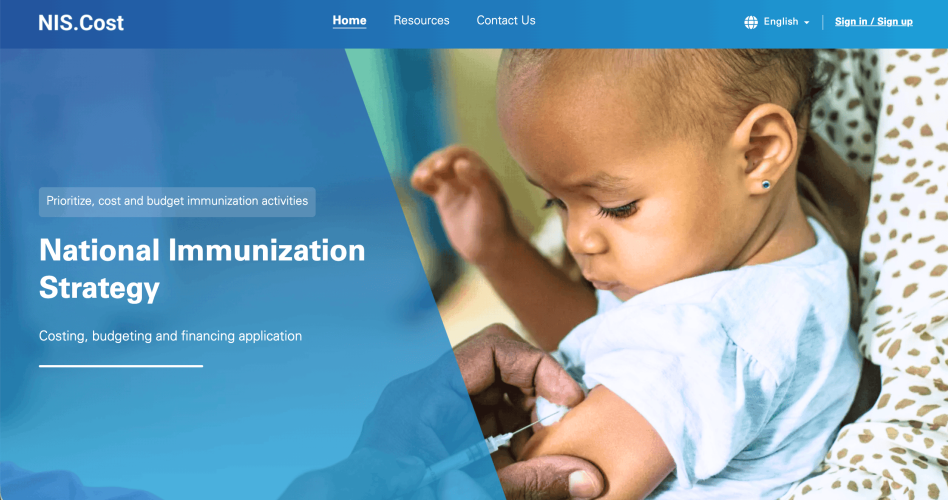
Every national immunization strategy begins with a question: can we afford to protect every child?
Today, governments in more than 60 countries have used NIS.Cost to help answer that question with evidence rather than estimates.
That statistic represents far more than platform adoption. It reflects years of partnership with Ministries of Health, UNICEF, WHO, Gavi and national immunization teams working together to strengthen one of the world's most important public health interventions.
It has been CSF's privilege to be involved for years, when we were first entrusted with a draft Excel workbook that eventually grew into a robust and flexible platform - designed for use, wherever it's needed.
Implementing a national costing platform is about far more than deploying software. It requires a robust architecture, a standards-based data model, flexibility to reflect national contexts, and sustained investment in the people and institutions who will ultimately own and use it. Building national capacity enables teams to plan, cost, and manage immunization programmes with confidence—ensuring that the platform remains sustainable long after implementation is complete.
NIS.Cost is implemented through long-standing trusted collaboration, with Community Systems Foundation providing ongoing technical development and implementation support. Together, the initiative helps countries strengthen the evidence base for immunization planning through a sustainable, standards-based national costing platform.
This week, UNICEF Afghanistan confirmed the successful completion of the country's National Immunization Strategy 2026–2030 using the new NIS.Cost web application. Afghanistan now joins Libya and Syria among the first countries to adopt the next generation of the platform, marking another important milestone in the evolution of this global public good.
Today, the NIS.Cost community includes:
- 61 countries that have implemented NIS.Cost Version 1
- 3 countries already using the new NIS.Cost Web Application
- A growing global community sharing a common approach to evidence-based immunization planning and sustainable programme financing.
Behind these numbers are thousands of critical planning decisions: which vaccines to introduce, how many health workers are required, what investments are needed in cold chain infrastructure, how programmes should be financed, and where scarce resources will have the greatest impact.
Accurate costing does not immunize a child. But it helps ensure that vaccines, health workers, logistics, and financing come together when and where they are needed. Better planning leads to better investment decisions, more efficient use of limited resources, stronger immunization systems, and ultimately more children protected against vaccine-preventable diseases.
As NIS.Cost continues to evolve, so too does the global community that relies upon it. The transition to the web platform represents more than a technological advancement—it strengthens collaboration, improves accessibility, and lays the foundation for continuous innovation in national immunization planning.
For Community Systems Foundation, the measure of success is not the number of countries using the platform, but the confidence of national teams to own, manage, and continuously strengthen their immunization strategies. Every implementation represents another step toward more resilient health systems, better-informed investment decisions, and a future in which every child has access to life-saving vaccines.